
Mobile VMS
Mobile Variable Message Signs on Trailer
Trailer-mounted variable message signs for roadworks, temporary traffic management and emergency situations.
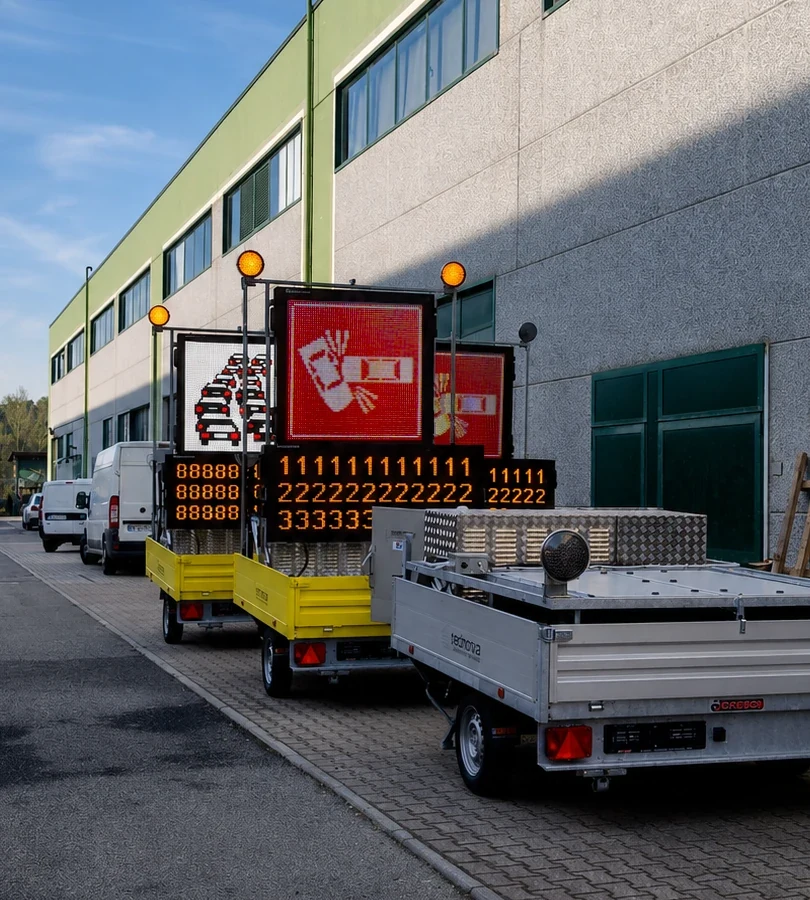
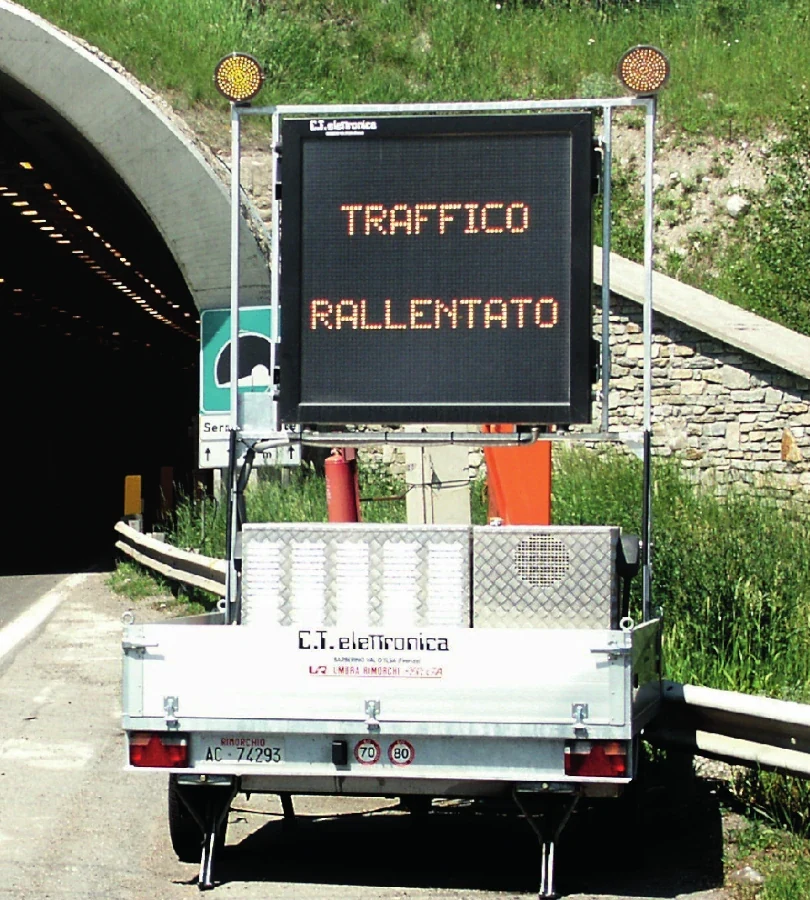
Trailer-mounted VMS are mobile road-signalling systems that can be operated directly from the onboard console or remotely.
In the standalone version, a diesel generator recharges the service battery. The low power consumption of the LEDs allows up to one week of continuous operation on a single tank of diesel, depending on the messages displayed and operating conditions. A version powered solely by the mains supply is also available.
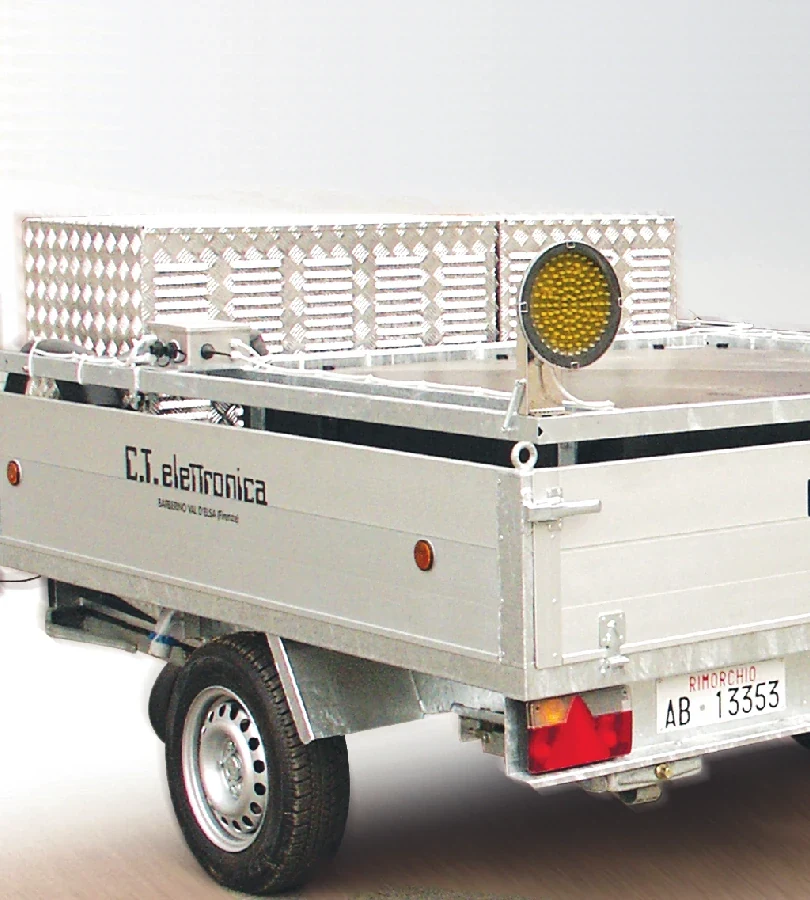
The trailer is available with or without a camera and can be configured as a mobile platform for integrating other equipment. The VMS, batteries, generator and electrical cabinet can be sized to meet specific requirements, allowing customised solutions for monitoring, safety and local infrastructure management.
Operational mobility
The trailer has a fully laden mass of 1,000 kg and can be towed by a suitable vehicle, facilitating movement between work areas. Towing must comply with the vehicle’s towing capacity and the driving licence requirements for the vehicle–trailer combination.
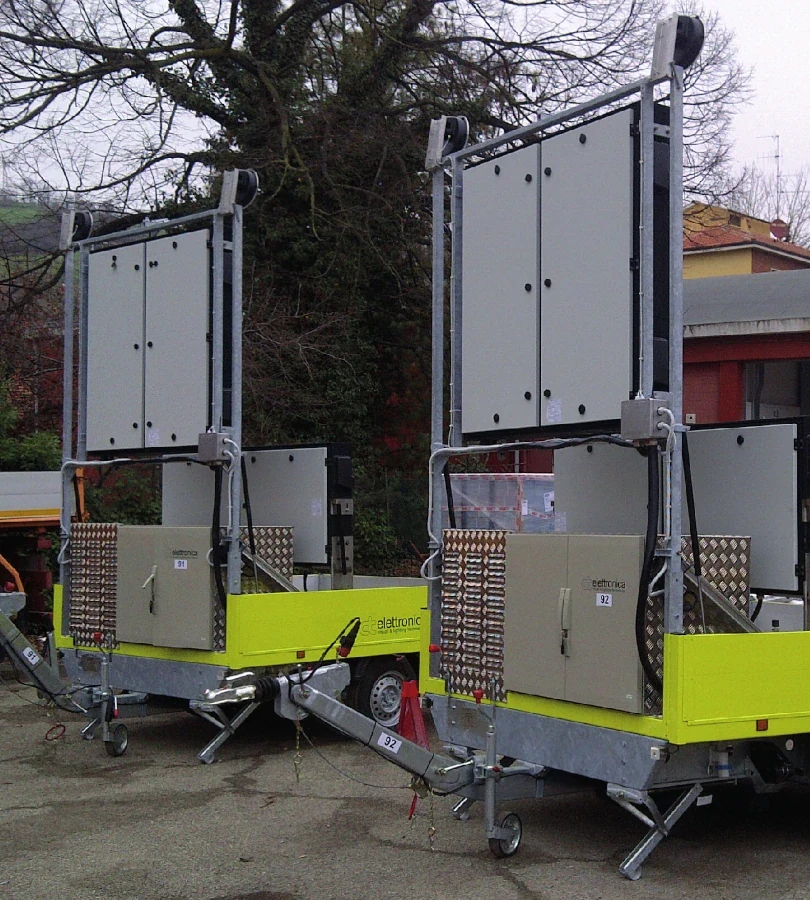
During transport, the signs remain lowered and secured in their stowed position. On arrival, the trailer is immobilised and stabilised before the VMS are raised to their operating position to display messages and pictograms.
Roadworks and diversions
Trailer-mounted VMS inform drivers approaching roadworks, diversions, lane restrictions and emergencies. The mobile installation allows the information point to follow changing site requirements.
Text and symbols can communicate the event and the instructions drivers need. Sign placement and message content must be defined in the traffic management plan for the operation.
Automatic brightness
The system automatically adjusts LED sign brightness to ambient light: messages remain clearly visible during the day, while brightness is reduced at night to avoid dazzling road users.
Reducing brightness also lowers energy consumption, helping preserve battery charge and extend the operating autonomy of the standalone version.
Text and pictograms
The alphanumeric sign displays text, numbers and punctuation using ISO 8859-1 encoding, while the full-colour graphic sign displays colour images and pictograms. Combining them allows a symbol to be accompanied by a written explanation, making the message clearer and easier to understand.
Messages can be set locally from the console inside the control cabinet, or remotely from a control room through the configured management system. Information can therefore be updated as traffic conditions and operational requirements change, without visiting the site.
Control and diagnostics
The trailer can be operated locally from the onboard console or remotely from a control room. The technical datasheet specifies the binary CTPROTOCOL over Ethernet or RS-485 and a cellular connection through an LTE router, depending on the supplied configuration.
Diagnostics identify faults in LED chains with front and rear localisation, individual driver outputs and power supplies. They also monitor fans, temperature at two points, internal memory integrity and the parallel matrix-control cable, identifying individual wires shorted to ground, the supply or other wires.
With Engiboard, the graphical interface provides a schematic view of the sign and its operating status, with different user permission levels. Messages can be managed through the web interface or a protocol. The listed options are WEB, MODBUS, CTPROTOCOL, SOAP, ANAS RMT, SIV/ASPI and NTCIP; availability and integration must be defined for the requested configuration.
Two power options
The standalone version uses a service battery recharged by the onboard diesel generator. The controller starts the engine when charge falls below the specified threshold and stops it when charging is complete; external charging from a 230 Vac supply is also available.
The mains-powered version runs on 230 Vac, 50 Hz mains power and requires an external electrical connection during operation. The console generator section is not enabled in this configuration.
The choice depends on the power available at the site and operational requirements. The diesel version’s operating autonomy depends on use, displayed messages and operating conditions.
Want to know more about this product?
Contact us for technical datasheets, available configurations and assistance choosing the right solution for your project.